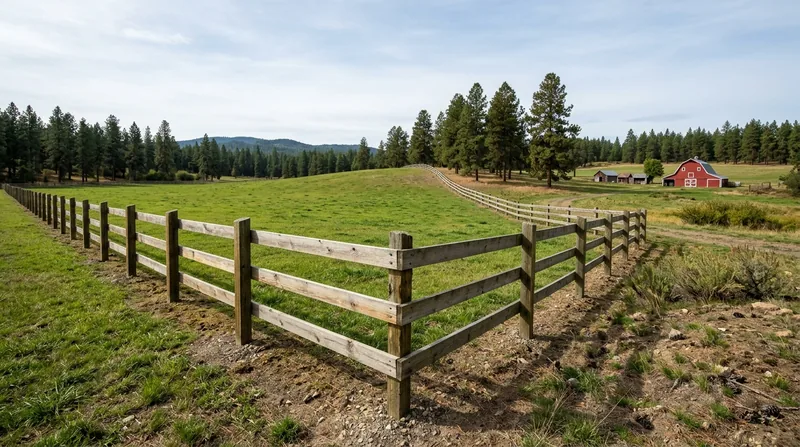




Farm & Ranch Fencing in Spokane: Straight Lines, Braced Corners, Gates That Swing
Acreage around Spokane is not flat pasture. From the pine-covered hills above Deer Park to the rocky benches west of Medical Lake, fence lines roll, cross basalt outcrops and pass through glacial outwash gravel that swallows a digging bar. That is why farm fence installation in Spokane is a different trade from building a backyard privacy fence. Long runs need true lines, corners need real bracing, and posts need to hold through deep freeze-thaw cycles that heave anything set shallow. We build ranch rail, no-climb horse fence, field wire and pipe fencing for landowners across Spokane, Lincoln, Stevens and Pend Oreille counties. The same crews set the posts, stretch the wire and hang the gates, and we will tell you plainly when a tired fence still has years left in it. If you are fencing a paddock or a full section line, start with a look at our home page and then call (509) 352-1315.
Why Farm and Ranch Fencing in Spokane County Fails First at the Ground Line
Most of the fence failures we see on acreage here are not wind damage and not livestock damage. They are post failures. The soil across much of Spokane County is thin and gravelly over basalt, so water drains fast but sits in the post hole after snowmelt, and the freeze-thaw cycle works the post loose year after year. A wood post rots at the ground line, and once it gives, the wire goes slack and the whole run leans.
- Posts set too shallow in gravel heave out of plumb after two or three winters.
- Corners without a proper brace let the line pull out of line under wire tension.
- Fall and winter windstorms drop pine limbs across long runs and push panels over.
- Dry, hot summers crack untreated rails and check them along the grain.
Getting the post depth, the concrete and the corner bracing right the first time is what separates a fence that lasts twenty years from one that needs re-stretching in five.
Key info: On the gravelly benches near Airway Heights and the basalt outcrops west of Spokane, we often have to set posts into rock rather than dig. That means a different anchor and a slower day, and it is one of the reasons a per-foot number on rocky ground is not the same as a per-foot number on deep soil.
Washington law requires an 811 utility locate before anyone digs a post hole, and that applies to long rural runs as much as to a backyard. You can read more about the requirement at the 811 Call Before You Dig site. We call it in before we set a single post.
How We Build a Ranch Fence Line That Holds Through Inland Northwest Winters
We walk the line with you before any equipment arrives. That walk sets the layout: where the fence runs, where the gates sit for trailers and tractors, and where the terrain forces a racked or stepped installation instead of a straight top line. From there the work follows a fixed sequence, and the sequence is what keeps a long run true.
- We call in the 811 utility locate and mark the fence line with you.
- We set corner and gate posts first, in concrete, because everything else hangs off them.
- We install H-braces at every corner and long pull, then run the line posts at consistent spacing.
- We stretch wire or hang rails under tension, then hang gates and check the swing and latch.
- We walk the finished line with you and correct anything that is out of plumb or slack.
For landowners in the Spokane Valley and out toward Liberty Lake who are fencing a smaller paddock rather than open range, the same sequence applies at a shorter scale, and our Liberty Lake fencing page covers the local ground conditions.
Key info: A recent job near Deer Park ran 900 feet of no-climb horse fence along a slope with two gates. The corners went into concrete with H-braces, the line posts were driven and tamped where the soil allowed, and the run was stepped rather than racked so the top line followed the grade without gaps at the bottom.
Farm and Ranch Fence Options and What Each One Is Built For
There is no single best fence for acreage. The right choice depends on what you are containing, how long the run is, and how much you want to spend on maintenance over twenty years. These are the systems we install most around Spokane.
| Approach | Description | Best for |
|---|---|---|
| Split rail | Wood post-and-rail in two or three rails, set in concrete at corners and gate posts | Property lines, decorative acreage frontage, light livestock |
| No-climb horse fence | Woven wire with small mesh, stretched tight on braced corners, often topped with a rail | Horses and foals, small paddocks, turnout areas |
| Field wire and barbed wire | Galvanized woven wire or barbed strands on treated posts, tensioned with stretcher bar | Cattle, large pasture, long economical runs |
| Pipe fence | Steel pipe posts and rails, welded or sleeved, set in concrete | Working pens, heavy cattle, high-traffic gates |
| Gates and openings | Tube gates, farm gates and custom openings sized for trailers and equipment | Driveways, pasture access, equipment crossings |
We size every gate for what actually has to pass through it, because a gate that is four inches too narrow is a daily annoyance for the life of the fence.
Farm & Ranch Fencing Cost in Spokane: What to Expect
Farm fencing is priced by the linear foot, and the honest starting point for basic ranch rail and field wire work is from $12 per foot. That figure covers standard line construction on accessible ground with normal post spacing. What moves it up is almost always the ground and the access, not the wire.
- Rocky ground that needs posts set into basalt adds time and hardware to every post.
- Long runs across uneven terrain need more corner and brace assemblies than a flat field.
- Pipe fencing and heavy-duty gates cost more in material than wood rail or field wire.
- Clearing brush or working around structures slows the crew and raises the per-foot number.
Two or three estimates on a long run is smart, and any contractor who will not walk the line before quoting is guessing. Our full pricing overview lays out the ranges in more detail.
Farm & Ranch Fencing Near Me: How to Choose a Contractor Around Spokane
Fencing acreage is a long-term purchase, so the contractor matters as much as the material. Ask for proof of general liability and workers' compensation cover, and ask for a certificate of insurance before work starts. In Washington, construction contractors are registered with the Department of Labor & Industries under RCW 18.27, backed by a surety bond and liability insurance, and you can verify a registration directly with L&I.
- Get two or three written estimates that describe the post spacing and bracing, not just a per-foot number.
- Ask for references from jobs of similar length and terrain, and call them.
- Confirm who handles the 811 utility locate, because it is required before digging.
- Check with your local building department and any HOA on height, setback and material rules before the line is set.
- Work from your existing survey and identify the line yourself, because only a licensed land surveyor can determine a boundary.
To get a walk of your line and a written estimate, contact us here or call (509) 352-1315.
Farm & Ranch Fencing in Spokane: Pricing Guide
| Service | Price | Details |
|---|---|---|
| Split rail fence | Starting at $12/ft | Two or three wood rails on treated posts, corners and gate posts set in concrete |
| No-climb horse fence | Starting at $14/ft | Woven wire with small mesh stretched on braced corners, often topped with a rail |
| Field wire and barbed wire | Starting at $12/ft | Galvanized wire on treated posts, tensioned with stretcher bar for long pasture runs |
| Pipe fence | On estimate | Steel pipe posts and rails welded or sleeved, priced after the line and ground are seen |
| Gates and openings | On estimate | Tube and farm gates sized for trailers and equipment, hung and latched on site |
| Travel | Included | in Spokane and surrounding counties, no separate call-out or mileage fee |
Indicative pricing, the exact cost depends on square footage, finish, and site access. Free personalized estimate within 24h at (509) 352-1315.


