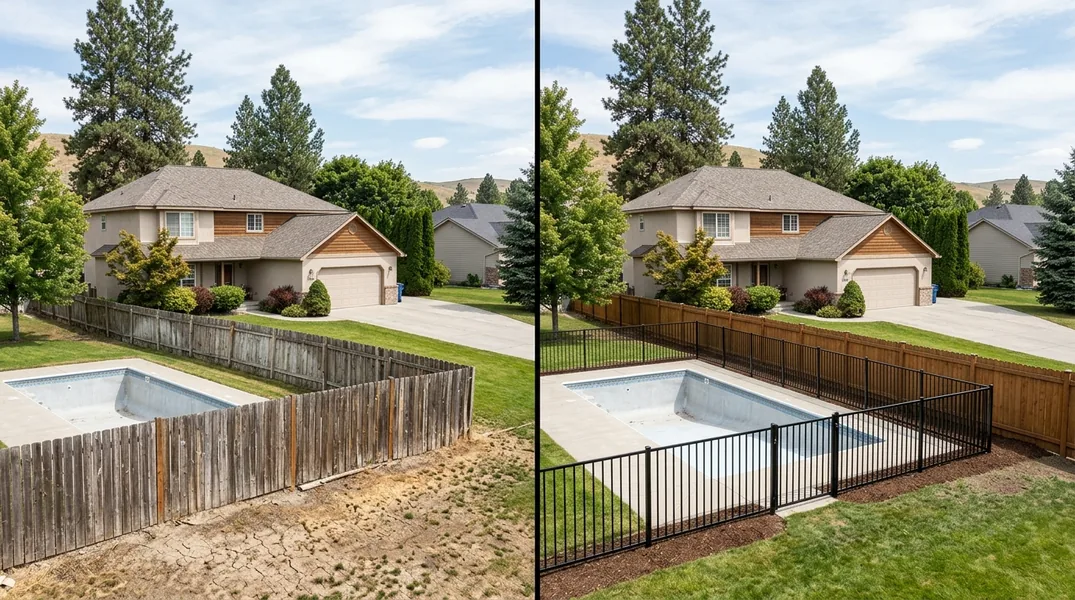
Why Pool Fence Rules Matter for Spokane Homeowners
If you are adding a pool to your backyard in Spokane, the fence around it is not just a design choice. It is a safety system, and Washington law treats it that way. The state has adopted pool barrier requirements that apply to residential swimming pools, spas, and hot tubs, and local jurisdictions may layer on their own rules during permitting. Before you buy panels or schedule a crew, it helps to understand what the code is trying to accomplish and which questions to bring to your contractor.
The short version is that a pool fence must keep unsupervised children away from the water. That means a barrier of a certain height, with no easy footholds, and a gate that closes and latches on its own. Homeowners who skip the research often end up with a beautiful fence that fails inspection, or worse, a barrier that looks secure but has a gap a toddler could slip through. A little preparation now saves time, money, and stress later.
Pool Fence Code Requirements in Washington: The Basics
Washington's residential pool barrier rules generally call for a fence or wall that separates the pool from the house and from the rest of the yard. The barrier must be at least four feet high, measured on the side facing away from the pool, and it must not have openings that would allow a small child to pass through. Horizontal members should be spaced so they do not create a ladder effect, and any gaps under the fence should be small enough to prevent crawling underneath. These are the core ideas behind most pool fence code requirements, and they are worth confirming with your local building department before installation.
Materials matter too. A chain link fence with large diamond openings may not satisfy the barrier standard unless it has a smaller mesh or slats added. A wood privacy fence with tight boards is often a strong choice, and ornamental metal can work if the pickets are spaced closely enough. The code is less about the material and more about the dimensions and the gate hardware. If you are unsure which style fits the rules, a professional can help you compare options like Wood & Privacy Fence Installation against Aluminum & Ornamental Iron Fencing for your specific layout.
Pool Fence Height Requirements and Gate Hardware
Pool fence height requirements are one of the most common sticking points. Four feet is the typical minimum, but some jurisdictions and some insurance carriers ask for five feet, especially when the fence is close to the water or when there are nearby structures a child could climb. Measure from the ground on the outside of the fence, and remember that grade changes can affect the effective height. A fence that is four feet at the flat section may be shorter where the yard slopes. This is a detail a good installer will check before setting posts.
The gate is where most safety failures happen. A self closing pool gate must swing shut and latch without anyone pushing it, and the latch should be out of reach of young children, typically at least 54 inches above the ground or otherwise designed to resist opening. Gates should open outward, away from the pool, and should not be propped open for convenience. If you have a gate that sticks or does not fully close, fix it before the next pool season. The same logic applies to Vinyl & PVC Fence Installation, where a lightweight gate can be more prone to drifting out of alignment over time.
Questions to Ask Before Pool Fence Installation Near Me
When you start calling contractors, treat the conversation like a safety review, not just a price check. Ask whether the company has pulled pool barrier permits in Spokane Valley or the surrounding areas, and whether they will coordinate the inspection. Ask how they handle grade changes, how they space pickets or boards, and what gate hardware they use. A contractor who answers these questions clearly is usually the one who has done this work before.
You should also ask about the fence line itself. Setbacks from the property line, easements, and utility lines can all affect where the fence can go. If you are in an HOA, ask for the architectural review requirements early. And ask for a written scope that lists the fence height, material, gate type, and latch specification. That document is what protects you if something does not match the plan. If you want to compare options and get a free estimate, a local crew can walk the yard with you and flag the issues before you commit.
Pool Fence Installation Cost in Spokane: What to Budget
Pool fence pricing in Spokane depends on linear footage, material, gate count, and site conditions. A basic wood privacy fence is often the most budget friendly per foot, while ornamental aluminum and vinyl tend to cost more but need less maintenance. Self closing gate hardware adds to the total, and so does any custom work around slopes, decks, or existing landscaping. Removal of an old fence and hauling away debris are separate line items on many bids.
Get at least two written estimates and make sure they describe the same scope. A low bid that leaves out gate hardware or skips the permit is not really a lower price. Ask whether the quote includes posts set in concrete, which matters for a barrier that has to stay straight and secure for years. Homeowners in Liberty Lake and Cheney should also ask about travel or minimum job charges. For a straightforward pool barrier, most projects land in a mid-range that reflects the safety hardware and inspection coordination involved.
Choosing the Right Fence Style for Your Pool Area
The best pool fence is the one that meets the code and fits how you use your yard. Wood privacy fencing gives you screening from neighbors and a solid visual barrier, which many families prefer around a pool. Vinyl offers a clean look with less painting, and aluminum or iron can preserve a view while still providing a secure perimeter. Chain link is the most economical option, but it usually needs mesh or slats to meet the barrier standard around a pool. Each style has tradeoffs in maintenance, cost, and appearance.
Think about how the fence interacts with the rest of your property. A pool barrier can double as a property line fence, but only if it sits in the right place and meets setback rules. Gates should be positioned so that swimmers and guests naturally pass through a self latching entry rather than climbing over. If you also need a standard perimeter fence, a company that handles Chain Link Fence Installation and other styles can plan both at once. Call Spokane Fence at (509) 352-1315 to talk through your layout and get a clear plan before the season starts.
Looking for a professional fence contractor in Spokane? Spokane Fence responds fast for all your fence needs.
Get a Free Quote